After a month of graft I’ve thrown my carpenter’s tool back in the attic. 20 desks of solid 7-ply, 200 foot of sanded scaffold boards, 1400 sq-foot of antique pine floor-boards, 4 massive wooden truss beams and 1 studio/event space near Bethnal Green maketh Roof Unit. The original idea spawned and built with Chris Littlewood back in !2006! is reborn in a new space with the old vibe that other photographers are colleagues not competitors, it’s better to work together and together the work get’s better. We have 2 desks left for rental and the studio is also available for hire. The desk depicted is within a nuclear storage area near Sellafield not the one’s we rent in London..
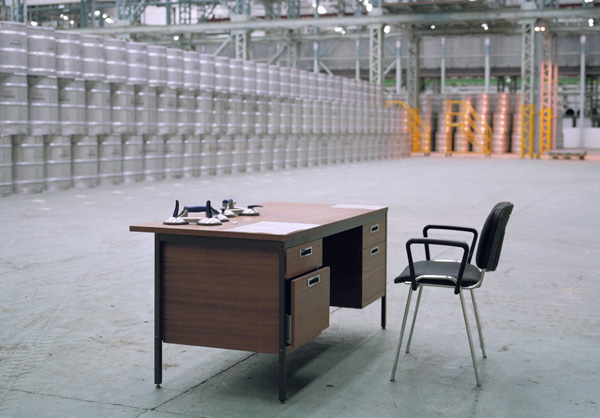
OK, enough with the cheesy metaphors. I’m very glad to be a photographer again and plotting what’s next; firstly some nocturnal and nuclear work in UK before wandering further afield. The current research and planning stage will involve reaching out to potential partner organisations whilst testing the water and potential of the subject matter. I would love to hear from anyone reading this who might want to get involved. You can reach me from the contact page or come on over to Roof Unit.
My project on Scottish Hydroelectricity has gained some great natural momentum in the last month. Firstly, I am extremely proud to see the work featured by National Geographic Online as part of an extended photo feature with additional reporting by Marianne Lavelle. The 14 page feature can be seen HERE. Secondly, I had the privilege of spending a long weekend in Teeside hanging and opening a solo show at Profile Gallery. The exhibition is showing in sunny Saltburn-by-the-Sea until the 21st of May. Finally, the results of the Magenta Awards 2011 have been revealed and I am chuffed to see my name along-side some great friends and photographers, looking forwards to it for the second year running.

Photography: Toby Smith
Editing: Holly Stead
London’s Olympic win had a bittersweet tinge in this 1,000-acre morass of derelict industrial land just three miles from the West End. In seven years, this will be the Olympic Park, boasting a spectacular array of stadiums and a pounds 650 million athletes’ village. And already its unique quality ” what psycho-geographers such as Iain Sinclair call a ‘liminal land’ ” a neglected in- between zone with its own unofficial, murky history ” is disappearing.
The Hackney fridge mountain ” Europe’s biggest ” is already gone, as are the Marshgate Lane allotments and the dog track. Can the cooking-fat recycling plants and the kebab-meat factories on Pudding Mill Lane and Waterworks River be far behind?
“The Independent on Sunday”
In The Picture: China’s New Energy Pioneers with Toby Smith
Photography
Date: August 24, 2011 7:00 PM
Venue: The Frontline Club
Photographer Toby Smith recently spent two months in China producing his latest project, China’s New Energy Pioneers.
He will be presenting his photography and discussing China’s environmental record in an event moderated by Jim Footner of Greenpeace.
Covering 11 provinces, Toby Smith’s work took him to coal mines, wind farms and hydro-electric plants while capturing the landscapes and people implementing the Communist Party’s latest Five Year Plan.Announced in March 2011, the new Plan is significant in its attempts to address escalating energy and environmental problems. A cap on coal dependency, ambitious targets for non-fossil fuel energy sources and a drive towards more renewable sources of energy reflect the Communist Party’s intentions to aim for a cleaner, greener kind of growth.With new power stations connecting to the grid in the People’s Republic of China at a rate of one per day, how China chooses to fuel its booming economy is one of the most important questions for the world of today, and of the future.
Toby Smith is a contemporary reportage photographer and director of Roof Unit, a collective of photographers based in East London. He specialises in environment and energy matters. Smith’s feature stills and video work has been published by National Geographic, the Guardian, TIME, the New York Times and the BBC among others.Moderator
Jim Footner manages the Climate Change Team of Greenpeace UK. Over the past nine years, he has worked on climate and energy issues for Greenpeace in various parts of the world including Asia. He led the Greenpeace campaign against new coal fired power stations in the UK, and co-ordinated the use of the Rainbow Warrior as part of an oil spill response team in Lebanon after the most recent conflict. Footner is also a trustee on the UK board of the French charity Development Workshop France, which specialises in resilient architecture and design in some of the world’s most hostile environments.
With its raging seas, wind-swept hills and high rainfall, Britain has more potential kinetic energy for capture than any other landscape in Europe. Nowhere is this concentration of energy more intense than the rich Scottish landscape where renewable energy has been providing power from the glens for over 60 years.
This video is a montage of the most compelling Time Lapse and HD videography to accompany the more comprehensive stills project.
Following on from my seminal project, Light After Dark, I now turn to to document the sustainable ‘alternatives’ available starting within the dramatic Scottish landscape.
This first phase of the project is kindly supported financially and with incredible access by Scottish Southern Energy (SSE). We have worked closely together this year to choose appropriate sites for the project based on aesthetic, cultural and historical significance.
I now hope to continue expanding this portfolio, in partnership with other industry experts, to raise awareness of sustainable energy production and its emergent technologies across Britain and beyond.